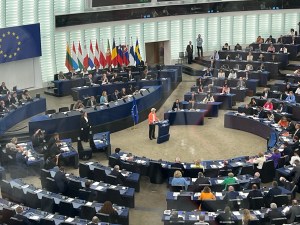
Strasbourg 13.09.2023 The Members of the European parliament debates the State of the Union speech the head of the European Commission Ursula von der Leyen delivered. Leaders of the political groups were the first to offer their opinions.
https://x.com/EuroParlPress/status/1701922632981971245?s=20
Manfred Weber (EPP, DE), highlighted three priorities. Firstly, economic growth and competitiveness, saying “we need growth, we need jobs, we need decent incomes, we need prosperity, we need a strong industry,” and welcoming initiatives to reduce red tape, invest in innovation, and cultivate trade relationships. Secondly, he cited migration, emphasising that Europe needs to decide who can enter at its borders and highlighting the “European DNA” of protecting refugees. Thirdly, he asserted the necessity for a European Defence Union and the need for ”optimism, vision, values and the readiness for the next step to become a real European Union.”
Iratxe García (S&D, ES) said the EU’s top priority should be reindustrialising to achieve strategic autonomy, while advancing the green transition to halt the consequences of climate change. She thanked President von der Leyen for her clear message in support of the Green Deal but regretted the lack of emphasis about consolidating the Union’s social pillar. Ms García called for the inclusion of gender violence to the list of EU crimes, and to use the frozen Russian assets to help fund the rebuilding of Ukraine. She also urged the EU to secure a deal on the migration pact and stressed that “Europeans’ money cannot end in the pockets of governments abusing people’s fundamental rights”.
Stéphane Séjourné (Renew, FR) emphasised the importance of making the most of the legislature’s remaining months. He highlighted the positive steps made in response to the pandemic, Russia’s aggression against Ukraine, and the European Green Deal. He demanded the EU focus on reindustrialising Europe and noted that the EU has now regulated the digital “wild west”. Mr Séjourné stressed the need for a lasting solution to migration issues. He also criticized the “poisonous” unanimity rule in the Council and urged Europe to heed the desperate pleas of judges in Poland and Hungary.
Philippe Lamberts (Greens/EFA, BE) criticised “those who are calling for a pause” in climate and environmental legislation, saying, “we are not above nature (…) whether we like it or not, there are limits to what our planet can take and to what it can give.” He said the ecological transition represents “the single biggest economic opportunity for Europe.” Lamberts also urged the European Commission to address housing issues and to step up its efforts against breaches of the rule of law, “and not only towards Poland or Hungary”.
“Is the EU in a better shape today than twenty years ago?” Ryszard Legutko (ECR, PL) asked. “The answer is no, as there is more than ever instability, uncertainty and the inflation is high.” “People smuggling is thriving, the Green Deal is a costly extravaganza, the cost of the EU’s common debt will be two times larger than predicted and the EU budget is in shambles”, he added. “The Commission slides towards oligarchy, meddling in national policies, and trying to topple governments they do not like, having made the rule of law a caricature.”
Marco Zanni (ID, IT) said that on the Green Deal, the EU has “a historical opportunity to be less ideological and more pragmatic,” adding that we need to tackle climate change without harming “our farmers, firms or buildings’ owners”. On the announced investigations into foreign subsidies, Mr Zanni questioned their usefulness, stressing that we already know that China is involved in unfair competition. On migration, he said that while EU fails to agree that “who has no right to be in, needs to stay out” it won’t be possible to “solve the issue”.
Martin Schirdewan (The Left, DE) said: “True political success is measured by the real-life situations of the majority of people, not by eloquent speeches.” He added that, despite lofty promises, the reality for many Europeans remains grim, with rising living costs and falling real wages. He highlighted the struggles of workers, single mothers, and retirees, accusing the Commission of fostering a Europe that increasingly serves corporations over its citizens while “95 million people in the European Union are threatened by poverty”.

 EUROPE DIPLOMATIC