Brussels 18.03.2024 “The presidential elections held by Russia on 15-17 March took place in a highly restricted environment exacerbated also by Russia’s illegal war of aggression against Ukraine” reads the statement by the High Representative Josep Borrell on behalf of the EU on Russian presidential elections and their non-applicability on Ukrainian territory. (Photo above: Crimea bridge).
“Russian authorities have continued to increase the systematic internal repression by cracking down on opposition politicians, civil society organisations, independent media and other critical voices with the use of repressive legislation and politically motivated prison sentences.
“The shocking death of opposition politician Alexei Navalny in the run-up to the elections is yet another sign of the accelerating and systematic repression. The elections took place in an ever-shrinking political space, which has resulted in an alarming increase of violations of civil and political rights, and precluded many candidates from running, including all those opposed to Russia’s illegal war of aggression, deprived Russian voters of a real choice and heavily limited their access to accurate information. The European Union will continue to support the important work of Russian civil society organisations, human rights defenders and independent media.
“The European Union regrets the decision of Russian authorities not to invite OSCE/ODIHR observers to its elections. This runs contrary to Russia’s OSCE commitments and has denied Russia’s voters and institutions an impartial and independent assessment of these elections” the statement concluded.
“Furthermore, the European Union strongly condemns the illegal holding of so-called “elections” in the territories of Ukraine that Russia has temporarily occupied: Autonomous Republic of Crimea and the City of Sevastopol, as well as in parts of the Donetsk, Luhansk, Zaporizhzhia and Kherson regions. The so-called “elections” in these territories represent yet another manifest violation by Russia of international law, including the UN Charter, and of Ukraine’s independence, sovereignty and territorial integrity. Referring to the two UNGA Resolutions of 12 October 2022 and 27 March 2014, we urge Russia to respect Ukraine’s internationally recognised borders and sovereignty. The European Union reiterates that it does not and will never recognise either the holding of these so-called “elections” in the territories of Ukraine or their results. They are null and void and cannot produce any legal effect whatsoever. Russia’s political leadership and those involved in organising them will face consequences of these illegal actions.
“The European Union reiterates its unwavering support for Ukraine’s independence, sovereignty and territorial integrity within its internationally recognised borders. Russia must cease its illegal war of aggression against Ukraine and immediately, completely and unconditionally withdraw its military forces and equipment from the entire territory of Ukraine”.
According to Russian TASS news agency the result of the elections were following:
“While 99.43% of ballots counted as of 7:00 A.M. Moscow time (4:00 a.m. GMT), Russian presidential race frontrunner and incumbent President Vladimir Putin leads the 2024 presidential race with 87.32% of the vote, according to information published on the Russian Central Election Commission’s official website.
“Communist Party candidate Nikolay Kharitonov is the runner-up with 4.32%, followed by the New People party candidate Vladislav Davankov with 3.79%. LDPR candidate Leonid Slutsky is fourth, garnering 3.19%”
Russian foreign ministry published their summery of the constructions works in Crimea conducted in last decade after the “re-joining homeland”.
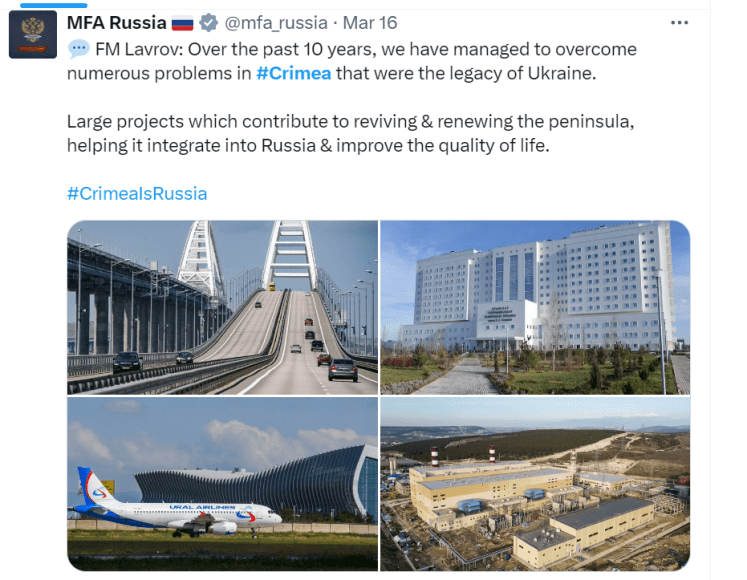
Crimea was part of Russia from 1783, when the Tsarist Empire annexed it a decade after defeating Ottoman forces in the Battle of Kozludzha, until 1954, when the Soviet era, the government transferred Crimea from the Russian Soviet Federation of Socialist Republics (RSFSR) to the Ukrainian Soviet Socialist Republic (UkrSSR). The transfer was announced in the Soviet press in late February 1954, eight days after the Presidium of the USSR Supreme Soviet adopted a resolution authorizing the move on 19 February the same year. The text of the resolution and some anodyne excerpts from the proceedings of the Presidium of the USSR Supreme Soviet meeting on 19 February were published along with the very brief declaration. Nothing else about the transfer was disclosed at the time, and no further information was made available during the remainder of the communist totalitarian political system.
By Anna van Densky from Brussels

 EUROPE DIPLOMATIC