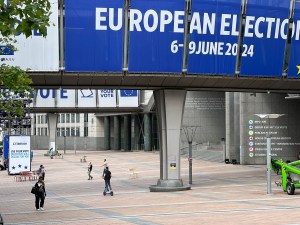
Brussels 09.06.2024 Today the Europeans in 20 EU member-states are going will drop ballots on the biggest and final day of voting for the European Parliament.

In a year of political junction these elections are pivotal, and the European vote is especially significant in view of fragmentation of the political process, contrasting, and even confrontational views of the future prospects, and fear of the loss of identity in face of mass migration.
The run-up to the vote has been marked by some minor incidents – although an attack that left Danish Prime Minister Mette Frederiksen with minor whiplash, and forced her to halt campaigning is not being seen as politically motivated. Denmark PM Mette Frederiksen is said to have been left shocked and suffering after being struck by a man while walking in the centre of Copenhagen. The assault took place in a square in the city’s old town when a man walked up to the politician and hit her. The attacker was swiftly arrested, but there is no word yet on a motive.
Europe’s main centre-right (Christian-democrats) grouping is expected to come top across the EU when first projections emerge later on Sunday, however three parties on the far right all have their eye on winning the most seats in the national parliaments.

France’s National Rally, Italy’s Brothers of Italy and Austria’s Freedom Party are leading in the polls, as is Belgium’s separatist and anti-immigration party, Vlaams Belang.
Voting already began on Thursday, June 6, Friday 7 June, and Saturday 8 June for some EU countries – but the majority of the member states are voting on Sunday. The European Parliament is the only elected EU institution.
This time in the EU elections is open voting for 16-year-olds in some member-states. Sixteen- and seventeen-year-olds will be able to vote for the first time in Germany and Belgium, increasing the size of Europe’s youth vote. Young Austrians and Maltese have been able to vote from 16 for some time, and Greeks are welcome to vote from 17.
In Germany alone there are an estimated 1.4 million eligible 16 and 17-year-olds among about five million first-time voters, so they could make a difference to the outcome.
The far-right Alternative For Germany (AfD) has claimed success in attracting young voters especially due to campaigns on popular social media platforms such as TikTok.

 EUROPE DIPLOMATIC