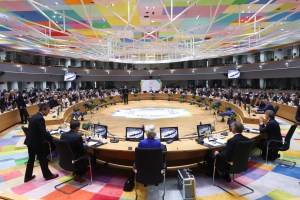
Brussels 17.10.2024 The first summit between the leaders of EU and Gulf Cooperation Council (GCC) countries took place in Brussels on 16 October, under the theme “Strategic partnership for peace and prosperity”.
“We share a common goal – to promote growth and to generate more prosperity for our citizens” said the European Council President Charles Michel.
The summit was co-chaired by the President of the European Council, Charles Michel, and the Emir of Qatar, H.H. Sheikh Tamim bin Hamad Al Thani, as the rotating President of the GCC.
The summit was an opportunity for the EU to develop a closer partnership with the GCC and its member states (the United Arab Emirates, the Kingdom of Bahrain, the Kingdom of Saudi Arabia, the Sultanate of Oman, the State of Qatar and the State of Kuwait), who are geo-strategic partners at a time of challenging geopolitical circumstances.
First European Union-Gulf Cooperation Council summit issued a joint statement agreeing to work together to promote global and regional security and prosperity, including preventing the emergence and escalation of conflicts and resolving crises by enhancing dialogue, coordination and engagement. They acknowledged the need to work together to deal with global challenges and support multilateralism. At the summit, EU and GCC leaders reaffirmed their joint commitment to a strategic trade and investment partnership, tapping into the opportunities offered by: an enhanced business and investment environment; the green and digital transitions; sustainable energy; connectivity.
The participants reconfirmed their shared interest to have a thriving and mutually favourable trade and investment relationship that must be developed, as appropriate, through multilateral, regional, and bilateral frameworks.
The EU and GCC countries will also seek to take forward discussions to reach a regional EU-GCC free trade agreement and explore tailor-made trade and investment agreements; aim to advance resilient, sustainable and global value chains; secure resilient energy supply chains including on clean technologies, raw materials and critical minerals.
Energy cooperation and climate change:
The EU and GCC countries committed to intensifying their energy cooperation to explore greater cooperation on energy security, including energy efficiency and renewable energies.
Leaders reiterated their respective commitments to scale up urgent action to address the crises and challenges posed by: climate change; biodiversity loss; desertification; ocean and land degradation;
drought; pollution.
The EU and the GCC are looking forward to successful outcomes at the upcoming COP29, with a decision on a climate finance that takes into account the needs and priorities of developing countries and is in line with the UNFCCC and Paris Agreement goals.
Strengthening connectivity:
In order to create a better digital world for future generations, the EU and the GCC agreed on the need to explore cooperation in: telecommunications; advanced technologies; the digital economy; innovation and space.
EU and GCC leaders reaffirmed their commitment to continue efforts to enhance people-to-people contacts by continuing to work together.
Ukraine:
EU and GCC leaders reaffirmed their respect for the sovereignty and territorial integrity of states, and their commitment to the fundamental principles of the UN Charter, international law and international humanitarian law.
In line with the UN Charter, all states must refrain from the threat or use of force to seek territorial acquisition against the territorial integrity and sovereignty or political independence of any state.
They stressed the importance of supporting all efforts to facilitate the export of grains and all food and humanitarian supplies to contribute to efforts aimed at achieving food security in the affected countries.
The EU and the GCC recalled the UN General Assembly Resolution ES-11/1, which “deplores in the strongest terms the aggression by the Russian Federation against Ukraine in violation of Article 2 (4) of the Charter” and “demands that the Russian Federation immediately, completely and unconditionally withdraw all of its military forces from the territory of Ukraine within its internationally recognised borders”.
They underlined d the need to reach, as soon as possible, a comprehensive, just and lasting peace in Ukraine in line with the principles of the Charter of the United Nations.
They also condemned attacks against civilians and civilian and critical infrastructure, especially in the energy sector that, amongst other things, increases risks in terms of nuclear safety.
Middle East
EU and GCC leaders expressed their utmost concern over developments in Israel, Gaza and the West Bank, and increasing tensions in the region.
In line with UN Security Council Resolution 2735, they called for an immediate, full and complete ceasefire, the release of hostages, the exchange of the Palestinian prisoners as well as immediate and unimpeded humanitarian access to civilian population, including the safe and effective distribution of humanitarian assistance at scale throughout the Gaza strip to all Palestinian civilians who need it.
EU and GCC leaders welcome the formation of the Global alliance for the implementation of the two-state solution, announced by Saudi Arabia, the EU and Norway, on 26 September 2024 in New York.
The leaders reaffirmed the unwavering commitment to the realisation of the right of the Palestinian people to self-determination through the two-state solution where Israel and Palestine live side by side in peace within secure and recognised borders, along the 1967 lines.
EU and GCC leaders are concerned by the military operations in the West Bank which have led to a high number of civilian casualties and destruction of civilian infrastructure, and call for their immediate end.
Lebanon
EU and GCC leaders are extremely concerned by the dangerous escalation in Lebanon, affirmed their support for the Lebanese people, and called for an immediate ceasefire. They also called for restraint and de-escalation and preventing the expansion of the conflict to the wider region.
The leaders called on intensifying international and regional efforts to provide urgent humanitarian aid to Lebanon. The EU and the GCC also condemned all attacks against UN missions and express particularly grave concerns regarding the recent attack against UNIFIL.
Iran
EU and GCC leaders stressed the importance of diplomatic engagement with Iran to pursue regional de-escalation. They stressed the importance of ensuring the peaceful nature of the Iranian nuclear programme, and ceasing of proliferation of ballistic missiles and unmanned aerial vehicles and any technologies that threaten the security of both regions and beyond as well as undermine international peace and security.
Red Sea
EU and GCC leaders reaffirmed their commitment to ensuring the freedom of navigation and maritime security in the Red Sea.
EU-GCC relations
EU-GCC relations are based on a cooperation agreement signed in 1989, which establishes regular dialogue on cooperation between the EU and GCC on economic relations, climate change, energy, the environment and research.

 EUROPE DIPLOMATIC
One Comment Add yours